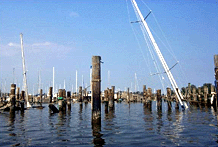
pilings, but was rising and falling with the wave action. Many of the finger piers had broken loose as well.
I could see that a section of dock with
my power and water pedestal attached had broken completely loose from the rest of the dock and was crashing
into my boat's stern. But there was nothing I could do at this point.
To make matters worse, the marina had flooded and a number of cars whose owners had chosen
to stay aboard their boats were out in the middle of the water. Several houses had flooded and someone's 275
gallon fuel oil tank had overturned and spilled its contents. The road leading to the peninsula had flooded
to about 5+ feet, and there were three trees and power lines down on the road, so we were all marooned. Two
news helos and one state police helo hovered around for about an hour looking at us. We looked back.
The water crested about 10:30 am, but the dock was in such bad shape that no one could get
to or from their boats (some folks had elected to spend the night aboard). I finally flagged down a kid on a
PWC and hitched a ride out to ENSHALLA. The scene was not pretty. The powerboat and sailboat at the end of the
dock had each sustained severe damage. The two were lying against each other. The powerboat was holed at the
sheer and the sailboat had heavy damage, including a missing portlight from banging against the powerboat. It
was apparent that the dock had failed first, as the sailboat (and maybe the powerboat, I can't remember) was
still attached to both dock rings and a piece of wood that had once been part of the dock.
The Morgan was the third boat in line and as mentioned earlier, was out in the fairway facing
the dock from whence she came. A smaller sailboat had been moored next to the Morgan and had been holed in the
starboard aft end. A Tayana 37 was in the next slip and had suffered fairly heavy damage on the port side due
I think to contact with the piling and with the small sailboat. Her starboard aft lines had parted. The next
slip upwind was empty; her owner having elected to go farther up river. Wish I'd thought of that. I will next
time.
My boat, ENSHALLA, was in the next slip. As mentioned before, the dock wall had collapsed onto
the dock, providing a very nice view of the now calm Chesapeake Bay. Large chunks of dock were missing and debris
was everywhere. The starboard side of the stern had quite number of gouges from where she had been attached by
the power pedestal, but none were too deep. The starboard aft lines had both parted, allowing her to get up
against the extreme topmost part of the midships portside piling. The aft section of the caprail on the starboard
side had significant grooves cut into it from the liens. The fender boat had apparently worked for a while, as
it had pretty heavy damage to the outer side of it. The piling itself had a half-moon shaped gouge out of it,
presumably from my stainless rub strake. The rubstrake had peeled back from the fir rubrail, which was heavily
damaged. However, the fiberglass had only a fairly minor abrasion on it as far as I could tell. It didn't even
rub though the gelcoat. Inside was completely dry, which was gratifying as I've just spent a fair part of the
summer replacing all the leaky chainplates and sealing the core around them.
My conclusion: I will NEVER EVER keep the boat in a slip again during a hurricane. What
was I thinking?!!!
The Trans-Atlantic Crossing
- Tom & Peg Maynard
S/V STARBOARD HOME, V40-268
On January 8, after a week of preparation, Tom, Peg and Garry cast off the lines and set
sail into the Atlantic Ocean. During our stay in the marina at Puerto Mogan, we made a new friend who owned
the boat berthed next to ours. She kept an eye on our boat while we were in the US for Christmas, writing us
to tell us that our "defenders" were in place, and was a wonderful, thoughtful and entertaining neighbor. It
was sad to say good-bye to Sophie Chacoux, our delightful French friend on her sailboat, ENOMIS.
Another person who was very helpful to us was Mayla, proprietor of the Sunshine Maritime Ship Chandlery. Mayla
helped us source many items, including a supply of dry ice and R134A refrigerant to keep our freezer, which
was having a
problem, going during the trip.
We motor-sailed until we were about five miles away from Gran Canaria. At that point, the
wind picked up, gradually building to 25 knots from the ESE, giving us a broad reach with the yankee and mainsail.
The waves also picked up and the rolling motion of the boat began to affect all of us. Garry put his Trans-derm
Scop patch on (probably should have done it earlier) and took advantage of being off watch to go down below to
sleep it off. Tom and I went directly to our usual mal-de-mer treatment: nibbling on dry crackers, keeping a
careful eye on the horizon, and limiting our charting, log-keeping and time below deck to only what was necessary.
A touch of sea sickness continued to affect all of us for the first two days, but we gradually
became acclimated to the waves and motion of the boat and by the third day, we were all starting to feel pretty
hungry.
When we first started the trip, it was quite cold at night, requiring us to wear everything
warm that we had, including a watch cap. The wind continued to blow from an easterly direction at velocities
ranging from 20 to 30 knots for the first eight or nine days. We were happy to be putting an average 150 nm a
day behind us. But the waves were at least 12 feet high and it was fairly strenuous sailing. It required quite
a lot of energy to move around the boat and carry out tasks, and a special agility and sense of balance to
prepare and cook meals. Tom carefully checked lines, sheets, sails and equipment daily for signs of chafe and wear.
We saw very little wildlife on this trip. A large pod of dolphins followed us for a while,
two days off shore; but away from shore, we saw no more dolphins or whales and no bird life. Every morning we
had flying fish of varying sizes and the occasional small squid on deck. We did some fishing and caught three
beautiful