Hurricane Ivan
- Jack & Cathy McCormick
S/V MARIAH BLAKE, V40-294
September 4, 2004
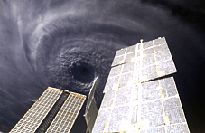
When Hurricane Ivan struck Grenada in September 2004, the eye passed right over the southern
tip of the island, with 130 mph winds. Due to insurance company
restrictions, most cruising boats who elected
to lay their boats up for the hurricane season and return home for the winter were forced to go to one of the two
yards in Grenada, or further south in Trinidad or Venezuela. Of the two marinas there, we happened to have picked
Grenada Marine (as did about six other lucky Valiant owners). This marina was further south and protected by
steep hills.
The boats that were hauled at Prickly Bay Marina did not fare as well. There were approximately 200
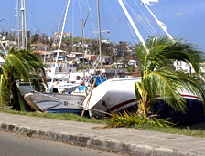
boats being stored there, and 100 percent of them received damage and were knocked over.
The poor Grenadians had severe damage to 90 percent of their homes and are still without power
and water. Even the president lost his home during the storm. To add to their miseries, the prison walls crumbled
and all the inmates walked away; including the prisoners of the coup that the US was involved in 15 years ago.
After the storm, the boaters on the island were a big help with outside communications on their
SSBs, Winlinks, and satellite
phones. Two days after the storm, we were grateful to have heard via Winlink that our boat, MARIAH BLAKE,
was standing and the mast intact. Most of the buildings in Grenada Marine were destroyed. A few days later,
we also learned that our sails and outboard, both stored in sheds, had also survived. We feel extremely lucky.
Hurricane Isabel
- Ray Russell
S/V ENSHALLA, V40-163
September 22, 2004
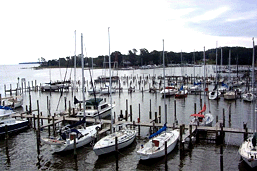
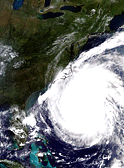
ENSHALLA is located at Bowley.s at the mouth of Middle River, above Annapolis. We're located
about seven slips from the far (westernmost) end of A-Dock, which is the southernmost dock in the marina, thus
closest to the Chesapeake Bay. Each dock holds about 55 or so boats. There is a breakwater between A-Dock
and the Bay, and
there is a wooden wall attached to the south side of the dock. The wall runs the entire length of the dock.
Each pair of boats is serviced by a finger pier running perpendicular to the dock. Our slip is 18-feet wide
and ENSHALLA is 12-feet wide, allowing less than three feet on each side. Our boat was oriented facing almost
due north (stern faced the bay). I doubled every bow, stern and spring line, which meant I had 16 lines on her,
all 5/8-inch premium three-strand. One pair of stern lines was attached to dock rings; the others were attached
to the pilings that supported the dock. All other lines went to pilings. I made the stern lines as long as I
could without letting her hit the pilings on either side.
I had removed everything that I could from the deck earlier in the week. In addition, I put
out a fender board with four fenders behind it on the port (west ) side, as
I expected the nastiest winds to come from the east, which turned out to be correct.
I napped in the cab of my truck and walked out once an hour to check on her until 11:30 when
the water was over the dock.
About 9:30 pm, the marina power failed. At 10:30 pm, part of the breakwater in front of
A-Dock collapsed into the dock, leaving the dock wall exposed to the swells. At about 11:30 pm, the water started
rising above the level of the dock and breaking over the dock wall, and I said goodbye to my boat for the last
time, as it was getting too dangerous to be out there. She was surging violently and heeling hard against the
ropes in the waves and wind, although the chafe protection I'd installed seemed to be working okay.
At about 2 am, things started to get nasty. Wind speed increased
significantly; rain came in
bands, but he winds were constant. Around 3 am, I could see from shore that a 40-some-foot-long powerboat and
a similar length sailboat downwind from me had broken loose and were partially out of their slips (they had
been in the two end-most slips).
A short time later, a Morgan ketch located downwind from me, but upwind from the first two
boats, had broken loose, and by means unknown to me had managed to leave her slip and get into the fairway
between the docks, attached only by a single bow line (she had originally been backed into her slip). As I
have a radome and a Firdell blipper radar reflector, ENSHALLA's silhouette is unique, so I could see that she
was about where she should be.
The news got significantly worse as the sun came up and I could see through binoculars from
the head of the pier that the dock was starting to come apart. The water level was above the dock wall and
waves were breaking directly against the sterns of all the boats. A significant portion of the dock wall had
collapsed onto the dock itself, and the whole mess was no longer attached to the